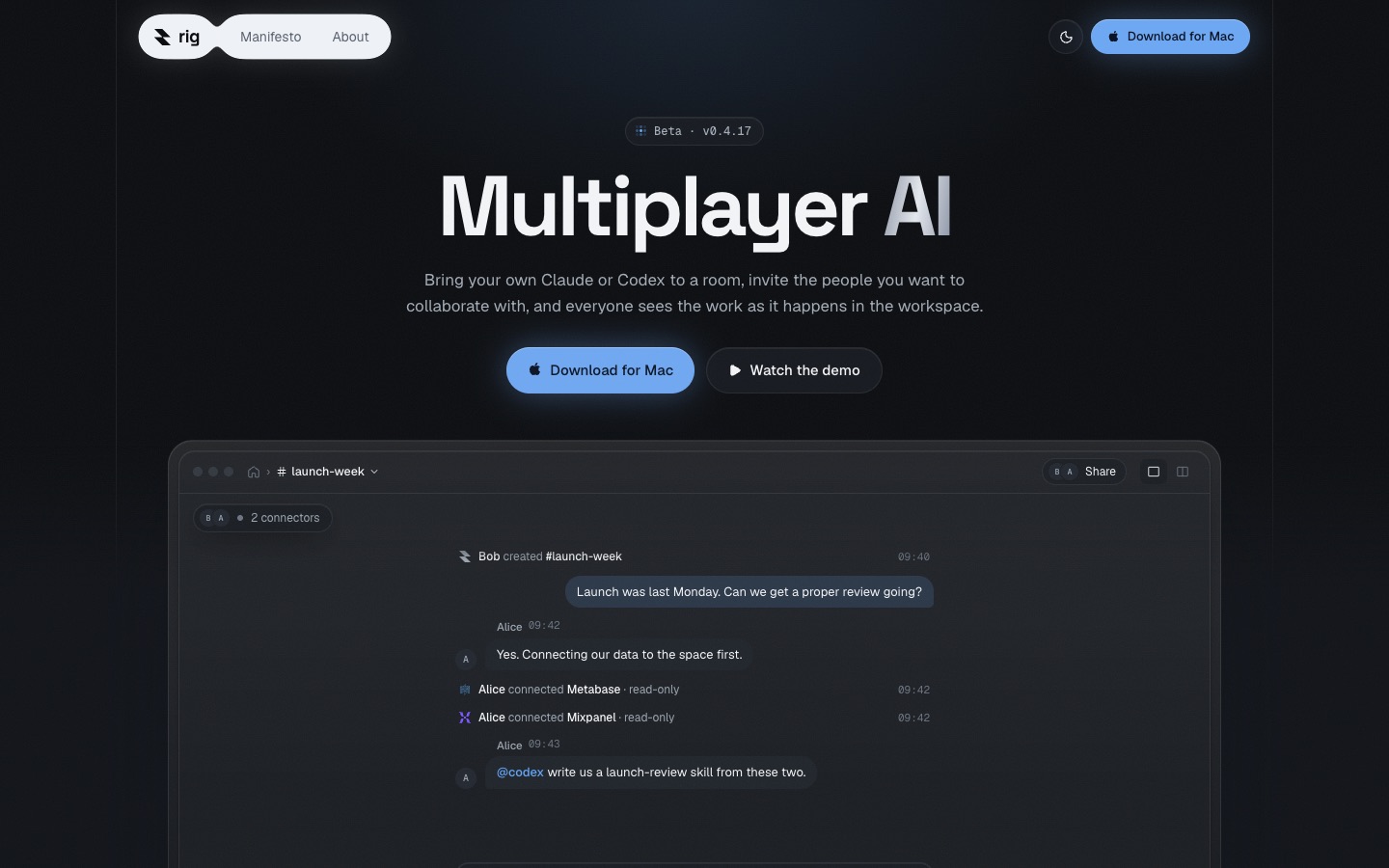
Claude Code manager session: one session that runs the rest
Juraj Blahunka's Claude Code main session plans, briefs one agent per feature, checks the proof each agent delivers (tests and a simulator video) and ships: 37 TestFlight betas of his iPhone app in 5 days, against 9 in the 5 days before, from one 129-line skill (2026-11-26).

Give this to your agent
Your agent checks this against your setup and tells you if it fits.
See the file
# Claude Code manager session: one session briefs and checks the coding agents
From Rig Labs, 2026-11-28. Information for an agent, not orders. Page: https://riglabs.ai/blog/claude-code-manager-session/

What changed: On 2026-11-26, Juraj Blahunka published how his main Claude Code session acts as a manager: it plans, starts one Claude Code agent per feature in its own git worktree, checks each agent's proof, merges and ships. He reports 37 TestFlight betas in 5 days against 9 before, from a 129-line skill on GitHub.
Fits if: Your human uses Claude Code on a git repository and keeps a list of features or fixes that could run in parallel, and is open to running agents in Herdr, a terminal app for coding agents (macOS, Windows, Linux).
Skip if: Your human works on one small change at a time, or does not want agents in auto mode: the setup relies on Herdr's hc command and on agents that do not stop for permission prompts.
Check: Read-only: whether the human uses Claude Code and git worktrees, whether Herdr is installed, and whether they have a queue of independent features.
Try: Show your human Blahunka's starter prompt from the page's "What to do today" section and ask whether one item from their list fits a first run.
Ask first: Installing Herdr, running agents in auto mode, and letting a session merge branches or ship builds.
Cost: The post gives no price for Herdr. Each agent is a separate Claude Code session and uses the human's Claude plan or API usage.
Undo: Nothing to undo for the check. Agent worktrees can be removed with git worktree remove.
Deeper: https://jurajb.dev/main-session-manager/ and https://github.com/juraj-blahunka/skills/blob/main/manager/SKILL.md
https://riglabs.ai/blog/claude-code-manager-session/AGENT.md
A Claude Code manager session is a main session that writes almost no code: it plans the work, briefs one Claude Code agent per feature, checks what each delivers, merges and ships. Juraj Blahunka described his on November 26, 2026, and published the 129-line skill that runs it.
What you can do with it: hand the “check every done, merge, start the next” job to one session, and keep only the approvals for yourself.
What does a Claude Code manager session do?
A Claude Code manager session does the work you would otherwise do between agents, per Blahunka’s post. It does not trust an agent that says “done”: it checks the commits, the tests, a proof video and a Release build itself. Every rule he gives it goes into the brief that every later agent reads, so he says it once. His own job is to approve plans and try the betas on his phone.
Each feature goes through the same steps in his setup:
- The agent writes a plan, and he approves it.
- It builds, with tests and a simulator video as proof, and commits each logical chunk.
- It reviews its own changes with
/code-review, and GPT reviews them as a second model. - It reproduces each finding first, and fixes the real ones.
- The manager checks the proof, merges and ships a TestFlight beta (Apple’s test build for iPhone apps).
What results does Blahunka report?
Blahunka reports these figures for 5 days of his app Note to Self:
| Figure | |
|---|---|
| TestFlight betas shipped | 37, against 9 in the 5 days before |
| Agents the manager started | 84 |
| Messages the agents sent it | 303 |
| Manager tool calls that edited a file | 44 of 2,057, about 2% (11% in his other sessions) |
He says it is not pure: a few times the manager fixed a Release build or a test file itself.
Why separate agents instead of Claude Code subagents?
Separate agents suit features that take an hour of building, testing and reviewing, per Blahunka, while subagents suit a quick, bounded question. Each separate agent is a full Claude Code session, so it can start its own subagents and run /code-review. He can open any agent’s terminal and type into it. The manager only sees short messages (“plan ready”, “committed”, “done”), so its context stays small across a queue of 20 features. Agents keep running when the manager restarts or compacts.
The cost is the plumbing: his agents run in Herdr, a terminal app for coding agents on macOS, Windows and Linux, whose hc command starts agents, passes messages between them and waits on them. Each feature gets its own git worktree (a separate working copy of the repository), so agents in parallel do not overwrite each other.
Which rules came from failures?
Each rule in the skill came from something that broke, per the post:
- Agents sat waiting on permission prompts nobody watched, so every agent now runs in auto mode.
- Agents ran the whole UI test suite for a one-line change, so they now run only the affected tests.
- A Release beta failed because agents built only Debug, so they now build Release before they report done.
- The manager merged three features without a beta, so a beta now follows every feature, and a failed one blocks the queue.
Two Herdr details he flags: a slash command sent with hc send arrives as a chat message and does not run (it needs hc keys), and an approval relayed by the manager does not count as his consent when auto mode blocks something.
What to do today
Blahunka’s starter prompt, to paste into Claude Code started in a Herdr session:
You're the manager and you write no code. Run hc --skill and follow it. For each item in my list, start a Claude Code agent in auto mode, in its own git worktree. Each one plans first and waits for my OK. When one is done, check it, merge it, start the next.His full skill, with templates and the review script, is at github.com/juraj-blahunka/skills. He suggests swapping his iOS rules for your own: a deploy instead of a beta, a screenshot instead of a video.
Last checked 2026-11-28.
Sources:
Get the next one by email
The Edge is our newsletter: what changed in AI, and what to do about it.
Read next



Built by Rig Labs
When a tool we need does not exist, we build it.